Native macOS app
SugarDash
The desktop command center for watching the fleet work. Optional — the web UI has the same board.
- Live floor of agents at work
- Streaming console
- Trends, task inspector, Coverage & Evidence
See what every agent is doing, stop duplicate work, and keep an evidence trail - across Claude Code, Codex, Cursor, Goose and your own agents. Local-first, one command to connect the harnesses you already use.
Claude Code · Codex · Cursor · Goose · OpenCode · DSH · your own scriptsSee the live demo →
Sugar is not one UI. It is one local control plane with a native desktop app, a browser Mission Control and an agent-facing CLI + MCP surface. Use whichever fits the person — or mix all three.
The desktop command center for watching the fleet work. Optional — the web UI has the same board.
The browser dashboard on macOS, Linux and Windows. Nothing to install for viewers.
Agents and scripts claim work, read shared memory and emit telemetry through the CLI or MCP.
sugar mcp tasks sugar mcp memorysugar add sugar emitAll three read and write the same local board and append-only event spine. No second source of truth.
You run four agents across three harnesses on one repo. Then the collisions start.
Two agents pick up the same issue at the same time. One overwrites the other, and you only find out when the diff looks wrong.
A crashed run keeps a task "claimed" forever. The queue quietly stalls and nobody knows which agent to restart.
"What happened yesterday, and which harness did it?" lives in six terminal tabs. You can't query it, replay it or hand it to anyone.
Tokens and dollars disappear into provider dashboards. You can't say what a task, an agent or a harness actually cost.
A prettier kanban doesn't fix this. The layer underneath does.
You shouldn't need six terminal tabs to trust a fleet. Sugar gives you one queue, one live view and one evidence trail - locally.
One agent gets the lease, written atomically with the task state. A crash requeues after the lease expires instead of leaving the queue stuck.
Watch current actions, failures and leases live - across harnesses - so a loop or a stalled agent is visible while it is happening, not the next day.
Usage and reported spend by task, agent, harness, project or day. No invented pricing table, and no provider dashboard archaeology.
Query the history, record verification results, and export a tamper-evident audit trail you can show a client, reviewer or auditor.
One local control plane. Any harness. The record to prove it.
A durable queue with atomic claims and leases, an append-only event spine, and one live view across every harness. Local-first, with memory shared between sessions and projects.
| Approach | What you get | Where it stops |
|---|---|---|
| Single-harness orchestrators | Better scheduling inside one tool | Other agents still can't see the queue |
| Kanban / dashboard UIs | Status, tickets, a nice board | No atomic claim, lease, provenance or spend |
| Cloud agent platforms | Convenience and a hosted runtime | Your code, history and cost model live in their cloud |
| Sugar | Durable queue, atomic claims, event spine, live fleet view, cost and audit, shared memory | It doesn't - local-first and harness-neutral |
[duplicate work, stuck queue, no record]
[no collisions, no lost work, queryable history]
The web dashboard and native macOS app share one REST + SSE API. Live agents, streaming tool calls, activity and trends - no refresh button, no cloud account.
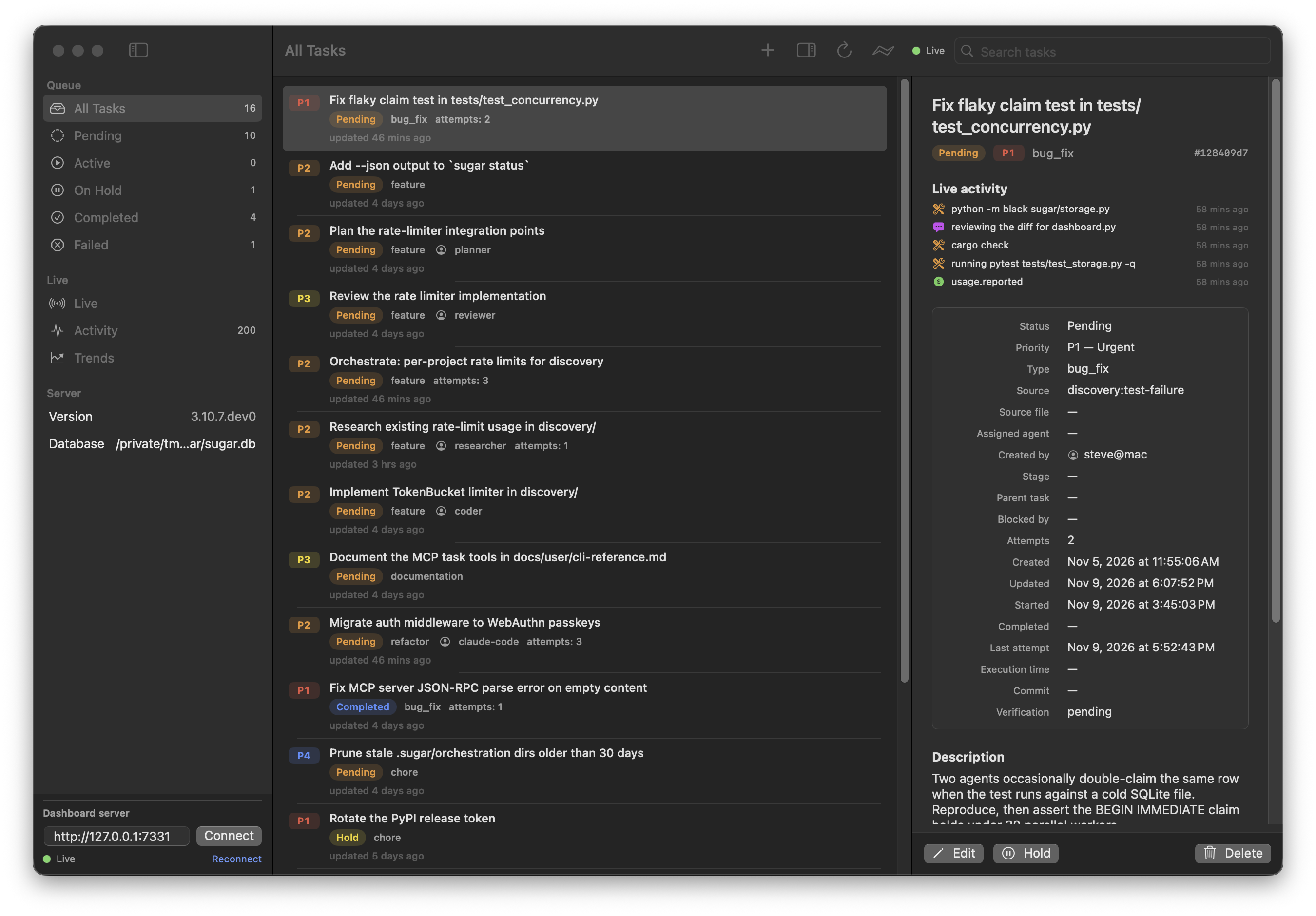
Native task board, live view, activity and trends. The inspector opens only when a task is selected; the queue gets the rest of the window.
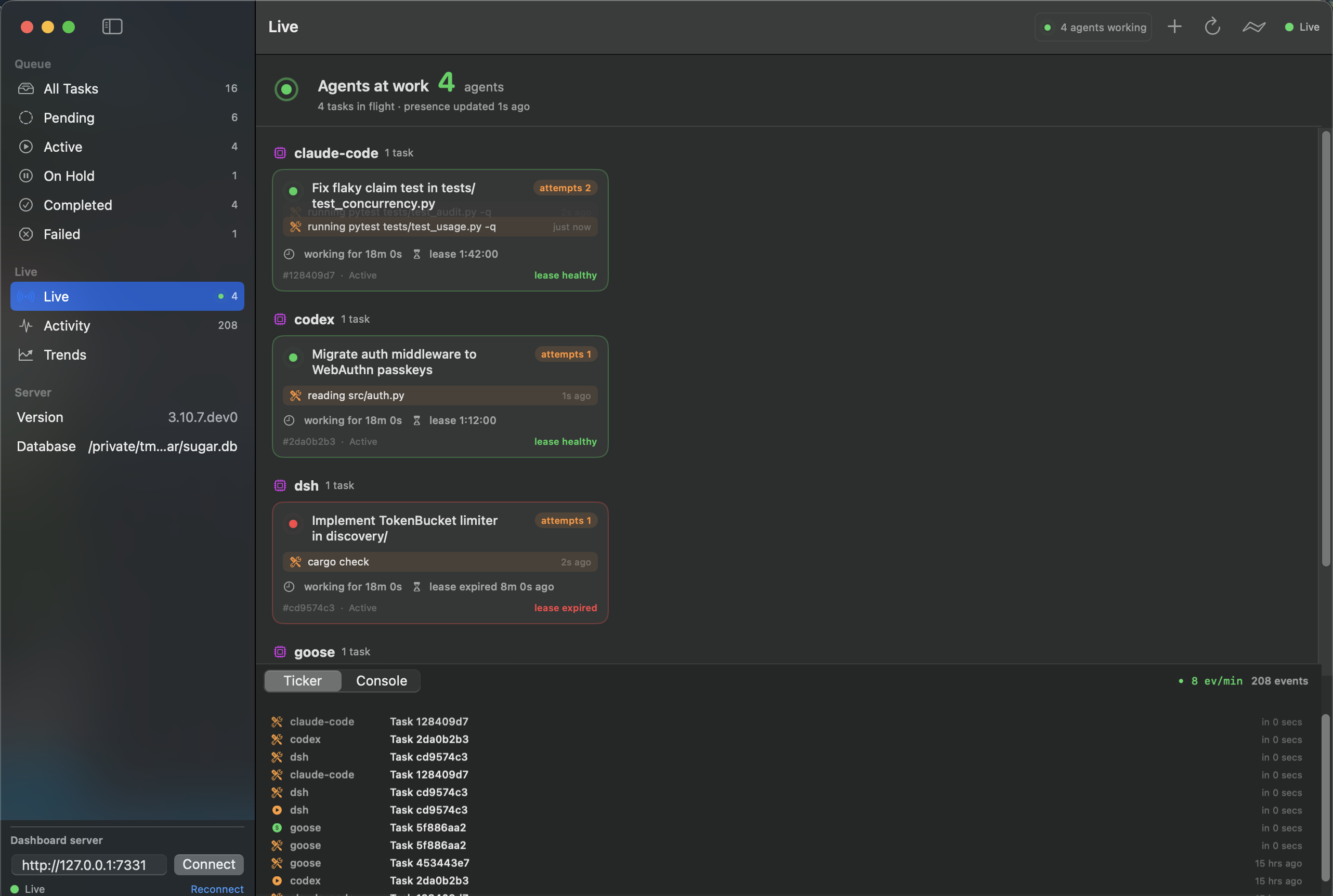
Real leases, current actions, health and countdowns for every agent in the fleet.
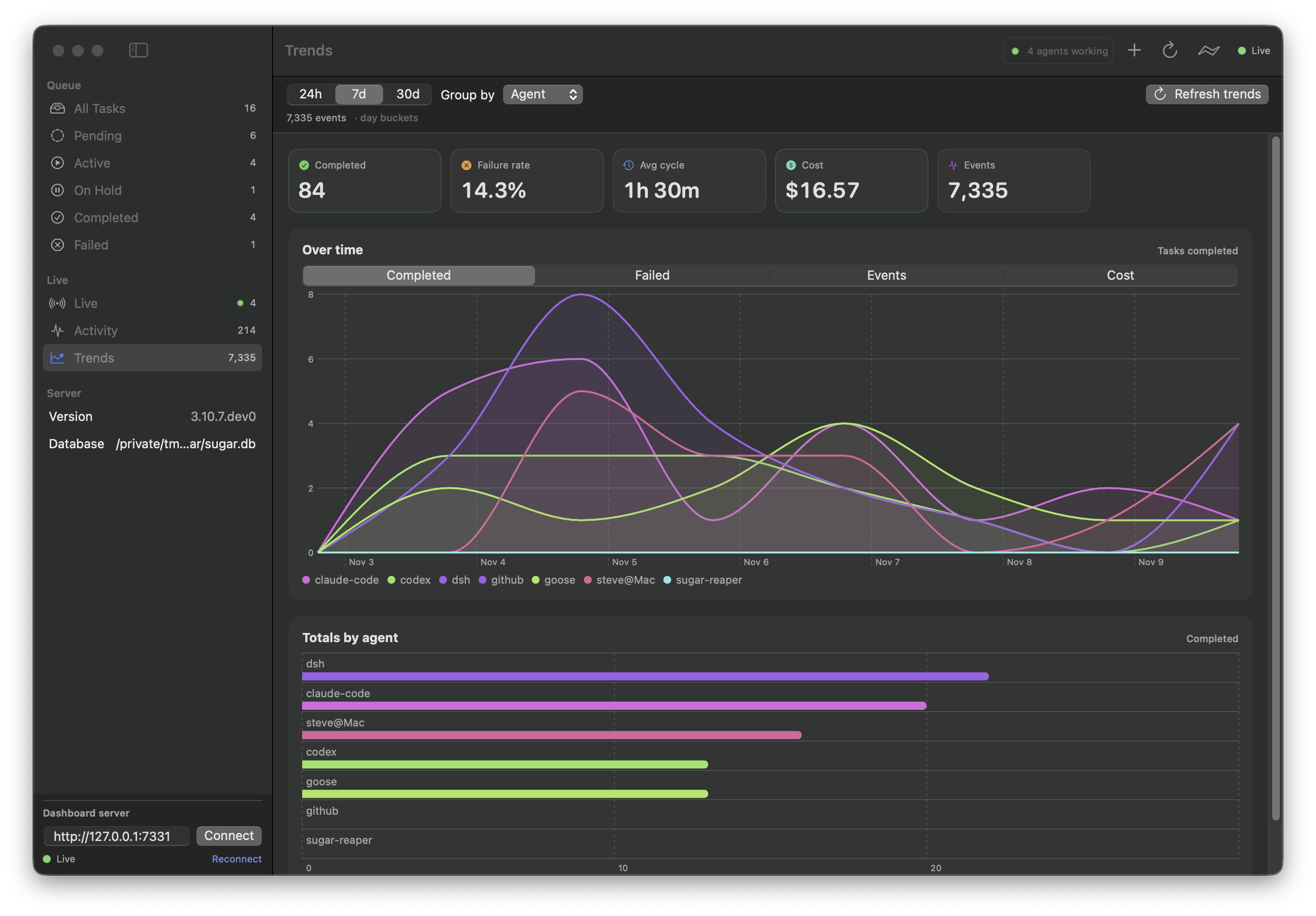
Throughput, failures, cycle time and reported spend over time - by agent, harness or project.
One command wires the harnesses you already use into one canonical event stream. No wrapper, no runtime to migrate to, no inflated coverage claims.
Claude Code HTTP hooks; Cursor, Codex and Goose command hooks.
L3 TOOL CALLSDeepSeek Harness compressed session logs, streamed with a resumable checkpoint.
L3 TOOL CALLSADK, Codex/Claude OTel and OpenAI Agents SDK helpers post the same canonical events.
L3 / L1Coverage is explicit: L3 tool calls, L2 tool names, L1 lifecycle, L0 board only. You always know what Sugar can - and cannot - see per harness. The dashboard runs in your browser on macOS, Linux and Windows; SugarDash is an optional native macOS client with a live floor, console and trends.
Coordinate, see and prove. Use one piece or all of them.
One agent gets the lease, written in the same transaction as the task state. Heartbeats keep it alive; expired leases requeue after a crash.
Blocked work stays blocked until its dependencies complete. Attempts, priorities, hold/release and retries are first-class queue state.
Claude Code, Codex, Cursor, Goose, OpenCode, DSH and custom scripts share the same queue through MCP, REST + SSE or the CLI.
Opt-in remote mode with scoped read/write bearer tokens. Self-hosted, TLS-ready behind your reverse proxy - nothing in a vendor cloud.
Web dashboard and native macOS app on one API: Live floor, streaming console, activity feed, task inspector and trends.
Harnesses emit tool calls, run starts/ends and usage with sugar emit or MCP. Watch it land live, per task.
Tokens and cost as your harness reports them, grouped by actor, harness, task, project or day. No invented pricing table.
Record tests, checks, reviews, approvals and commit links against tasks; browse the ledger in Mission Control, then export canonical JSONL with a SHA-256 manifest and verify it.
Tasks, event spine and memory are SQLite files on your disk. Loopback by default; no account, no repo upload.
Your agents keep their own subscriptions and workflows. Sugar doesn't replace them or route code through a vendor.
Atomic claims, lease heartbeats, crash reaping and dependency gating are covered by a backend-agnostic conformance suite.
Dual-licensed AGPL-3.0 + commercial, with a frozen REST/SSE contract, event schema and adapter playbook.
Decisions, conventions, error patterns and file context stored per repo, recalled across sessions.
Standards and guidelines at ~/.sugar/memory.db that surface in every project.
Local embeddings plus FTS5 fallback - context by meaning, not just keywords, with no external API calls.
Tasks and memory exposed as MCP tools, so any MCP client can read context, claim work and complete it.
No cloud, no account. Install, point your harnesses at the board, keep the receipts.
One pipx install, one init. Sugar creates a local SQLite board and its event spine. No accounts, no API keys.
Wire telemetry with sugar connect, then add the task and memory MCP servers. Any MCP client works.
Add tasks from the CLI, REST API or a discovery source. Agents claim them through MCP - atomically, with a lease.
Open Mission Control to see the fleet work. Optionally use the built-in runner; every harness keeps its own workflow.
Solo developers with a two-agent workflow, AI-native product teams, and anyone who has to prove what the fleet did.
Run Claude Code for one task and Codex for another without losing track of who owns what. One board, one history, no collision.
Give 5-30 agents one durable queue with dependencies, leases and cost attribution. See where the spend goes and which harness earns it.
Keep the evidence trail local: provenance, usage, and tamper-evident audit exports you can hand to a client or auditor. No vendor keeps your history.
Install in 30 seconds. Point your harnesses at the board. Keep the receipts.